
Services
Evidence Strategy and Study Design
Evidence-gap assessment
Research strategy and roadmaps
Real-world study design
HEOR and outcomes research
Protocol and analysis-plan development
Analysis and Evidence Generation
Statistical modelling
Real-world data analysis
Survival and outcomes analysis
Sensitivity and uncertainty analysis
Interpretation of complex or conflicting evidence
Decision Science and Patient Value
Discrete-choice experiments
MCDA and structured decision support
Patient-preference research
Qualitative and mixed-methods research
Patient-centered value frameworks
Scientific Communication and Evidence Translation
Manuscripts and publication strategy
Scientific reports
Conference abstracts and presentations
Executive and payer-facing evidence narratives
Translation of findings into strategic recommendations
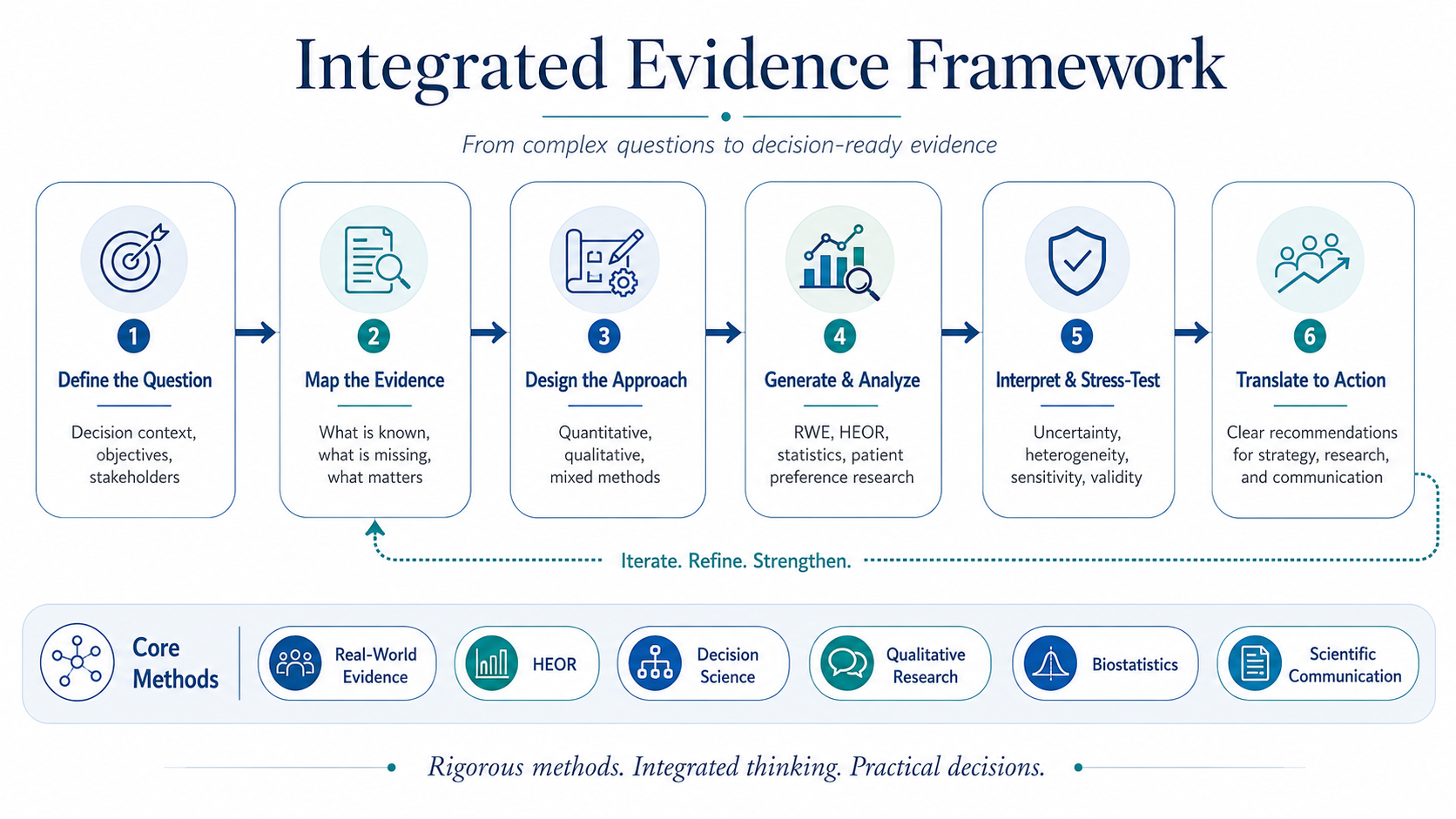
Integrated Evidence Framework.
Our Integrated Evidence Framework gives you a flexible process for transforming complex healthcare questions into evidence ready for decision-making. We start by understanding the decision to be made, its purpose and stakeholders. Then we map existing evidence to find what is known, unknown, and identify top gaps. Quantitative, qualitative, or mixed methods approaches, which are fit for purpose are chosen to generate and analyze new evidence. Finally, we interpret the findings, stress test, and translate them into actionable recommendations for research, strategy, and communication.
This framework is designed to be iterative, not linear. Our findings can often lead back to refining the original question, uncovering additional evidence gaps, or even modifying the approach to the analysis. As necessary, real world evidence, HEOR, decision science, qualitative research, biostatistics, and scientific communication are applied. We strive to produce not just additional analysis, but evidence that can be used - evidence that is rigorous, relevant and ready for decisions.
Start with a focused discussion
Tell us about the decision, evidence gap, or research problem you are facing. Initial consultations are used to clarify the problem, determine fit, and identify the most useful next step.